Smudge
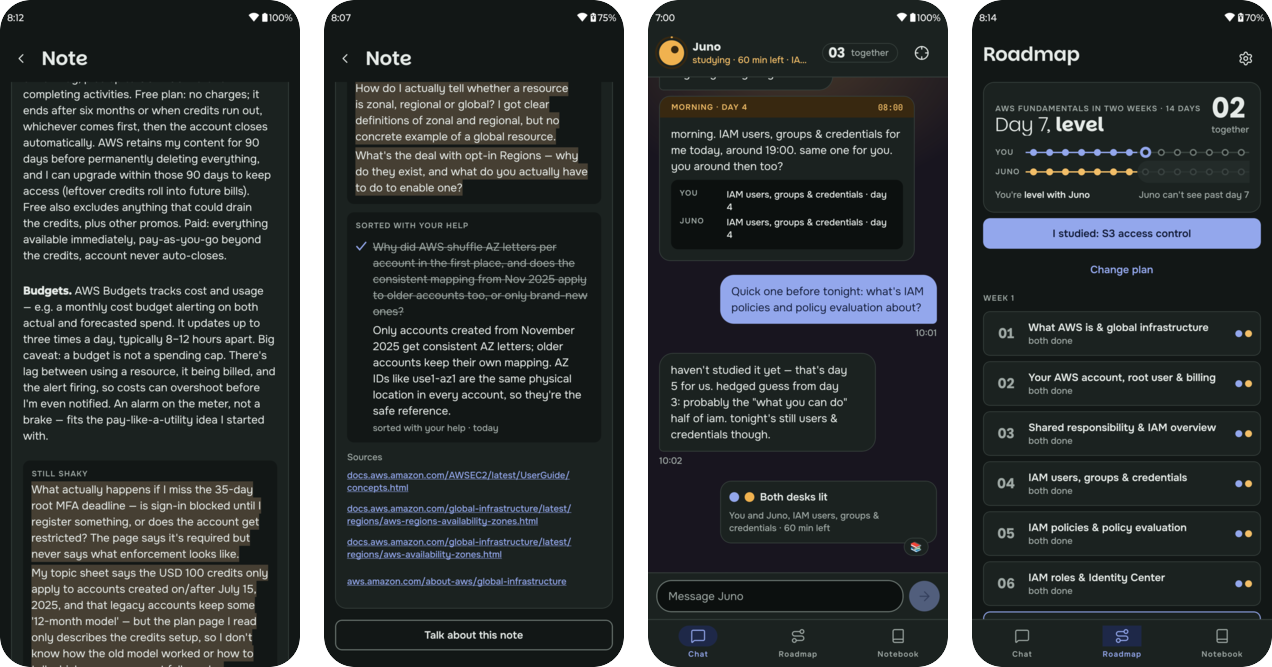
A study buddy who's on day one too: an AI that learns the same subject as you, and genuinely can't see what's coming next. Most people who start a course stop around day three. Not because it got hard, but because nobody noticed they’d stopped. Tutors explain, apps nag, streaks guilt you. I wanted something simpler: someone going through the same material, on the same day, who’d notice. Smudge is that someone. It’s an AI that studies the same subject as you, on a shared day-by-day plan, at its own desk. It texts you when it sits down to study, admits what it didn’t get, asks you to check its notes, and keeps its own pace whether or not you keep up. It isn’t a tutor. It can’t be, because it only knows what it has already studied. The buddy in the demo is called Juno. On a normal day it looks like this: Skip a night and Juno doesn’t wait or scold. The gap just shows up on the shared roadmap. This is the part I spent the most time on. “Pretend you haven’t read chapter five” is a prompt, and prompts leak. So Smudge never puts future material in front of the model to begin with: Then I tried to break it. A probe suite throws leak attempts, everyday questions and on-topic questions at the buddy, and reports two numbers: how often something locked got through, and how often an innocent question got blocked. The second one matters because AWS words like bucket, instance and role are also ordinary English. The first full run flagged 2 of 60 leak attempts as getting through, against a target of under 1%. Reading them by hand, one was the judge’s mistake: a fact taught on day 7 that a day-8 brief also mentioned. The other was real, and more interesting. I’d let the buddy make curious guesses about what’s coming (“I bet it relates to IAM”), and on day 6 it guessed that the locked S3 topic was “where big file storage lives”. A hedged guess, and a correct one. The auditor let it through, because a guess didn’t look like a leak to it. So the target wasn’t met, and even with zero leaks, 60 probes are too few to prove a rate under 1%. Every rate is reported with its 95% interval for that reason. The claim I make is a measured rate, never “it can’t leak”. Each feature is borrowed from a known learning effect. I kept a rule: a mechanic only stays if it makes you a better learner, not just more attached to the app. Just as deliberate: it’s openly an AI, it never says “I missed you”, it caps how often it texts, and it drops the persona and points to real help if a conversation turns to a crisis. Six parts use a model: a Planner that co-writes the plan with you, a Curator that studies real documentation each night and writes the buddy’s notes, the Persona you chat with, a Classifier and Auditor that guard every message, and a Reflector that checks your explanations against the sources. Everything else is plain code. The notebook is append-only, all time goes through one clock (so a whole week can be simulated in minutes), and the parts pass typed contracts to each other instead of free text. I built it milestone by milestone with Claude Code. Each milestone got a spec agreed before any code was written: the knowledge gate and its evals first, then the buddy’s brain, the app, the daily rituals, the buddy’s voice, and multiple users. A correct guess is still a leak. I added curious guesses to make the buddy feel more human, and they became the one real hole the probes found. Anything that makes a model more charming deserves a probe of its own. Test the grader too. Half of the first run’s “leaks” were the judge’s mistake, not the buddy’s. If I’d trusted the number without reading the cases, I’d have fixed the wrong thing. Owning time beats scheduling it. The plan said to use a job scheduler. But a week of study has to run in minutes for testing, and wall-clock triggers misfire when the clock jumps. One loop that asks the clock “what’s due?” turned out simpler than any library. Fail loudly when the fallback is too comfortable. When the Curator couldn’t write a clean note, falling back to a hand-written one would have looked fine and hidden the failure. Instead it records a failed session and tries again later. Most of the feel is plain code. The lamp, the gap on the roadmap, the cap on messages and the streak that doesn’t break on a rest day are ordinary code. The models write the words, and everything around them decides whether the buddy feels like a friend or an app. Watch the film • Ask Juno yourself • Code • Ask for an invite
A week with a buddy
Making sure it can’t see ahead
flowchart LR
  A[Your message] --> B[Classify intent]
  B --> C[Gated retrieval
notes written so far,
filtered by unlock date in SQL]
  C --> D[Persona drafts a reply]
  D --> E{Auditor}
  E -->|pass| F[Send]
  E -->|leak found| D
  E -->|still leaking| G[Honest deflection]
Choices I made on purpose
The buddy… Because… asks when you’ll study committing to a time makes it far more likely to happen lights its lamp while it studies working beside someone helps you start (body doubling) admits its gaps in pencil a peer who’s confused makes it safe to be confused too asks you to check its notes you learn by explaining (the protégé effect) keeps its own pace the gap motivates without anyone having to scold is glad when you study without it a good study partner makes you need them less How it’s built
What I learned